
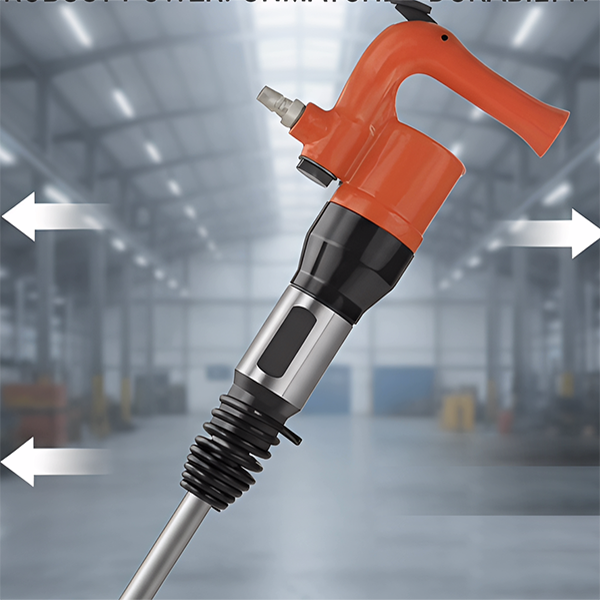
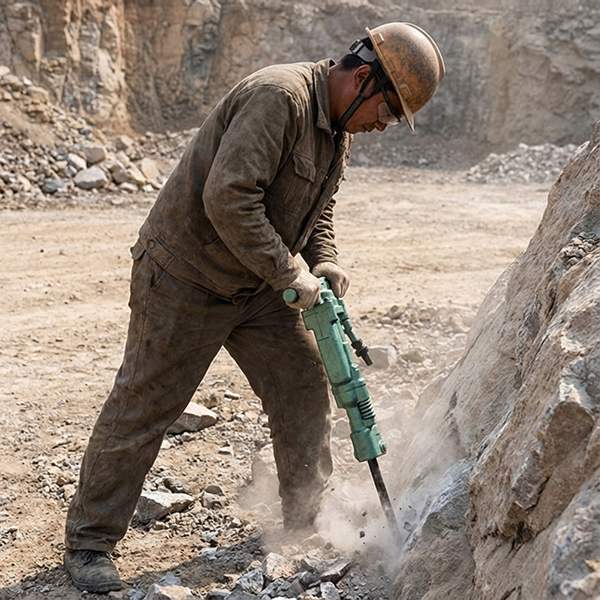
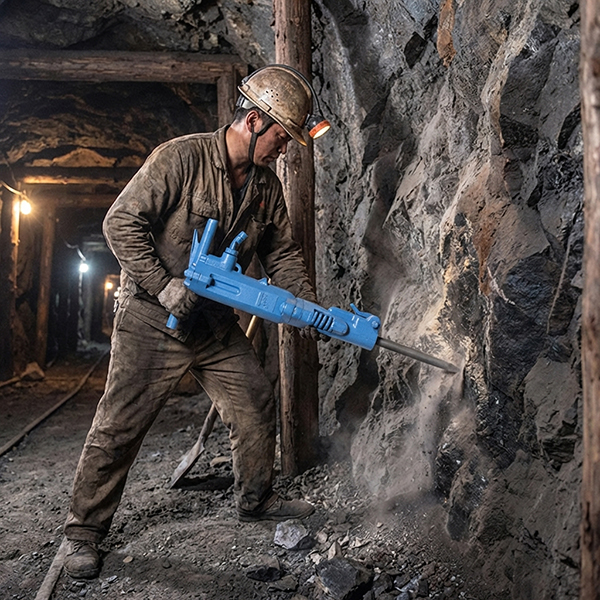
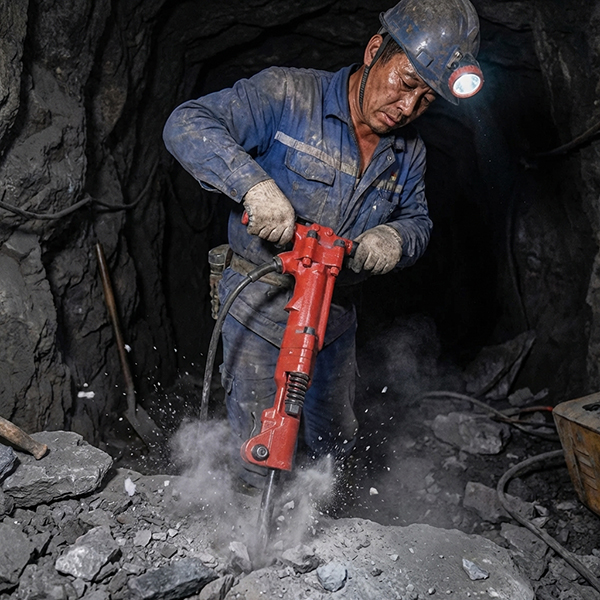
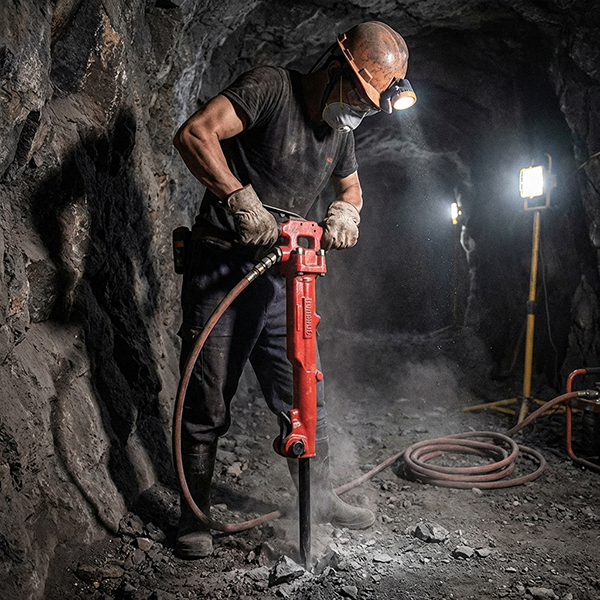
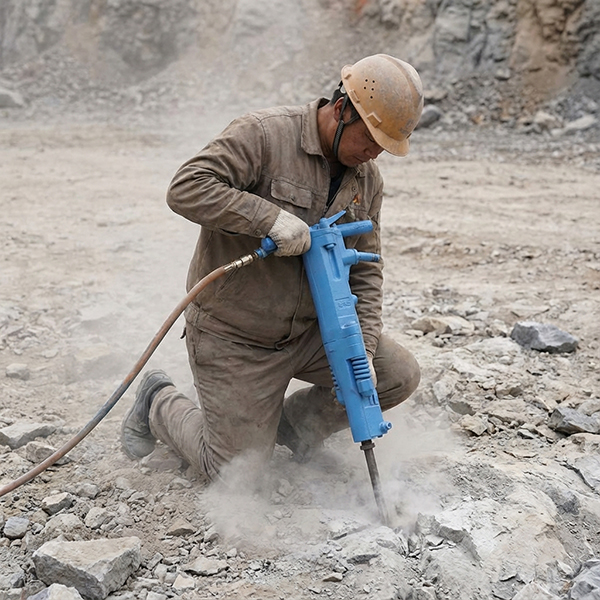
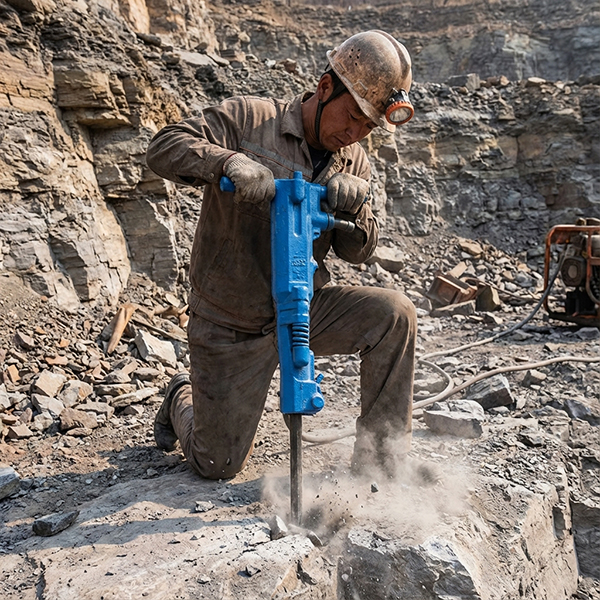
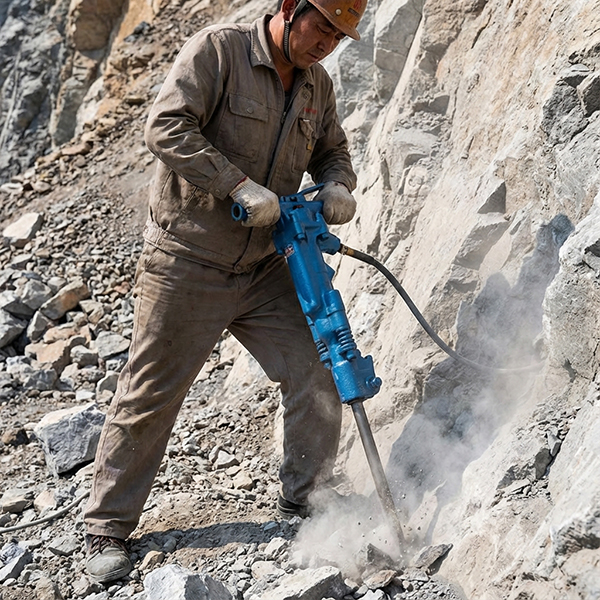
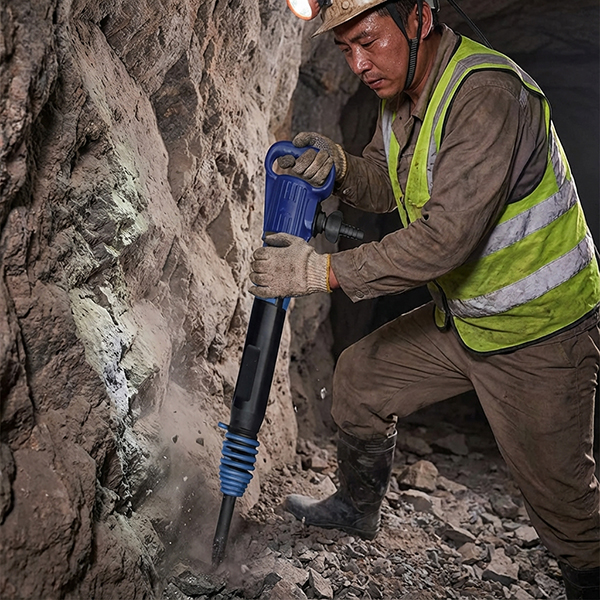
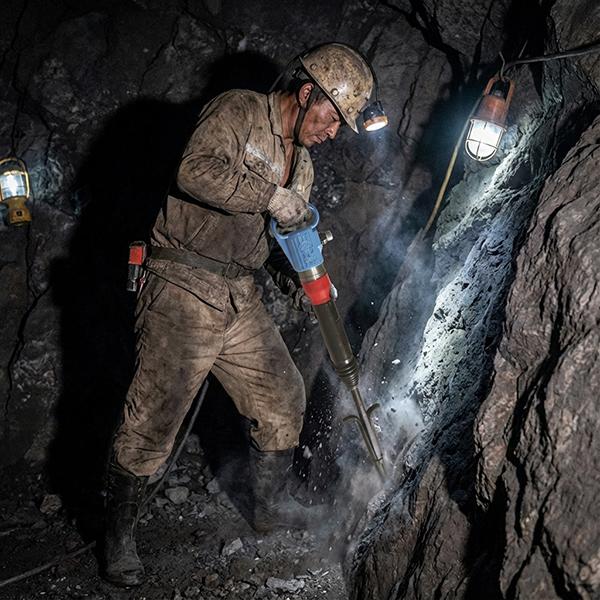
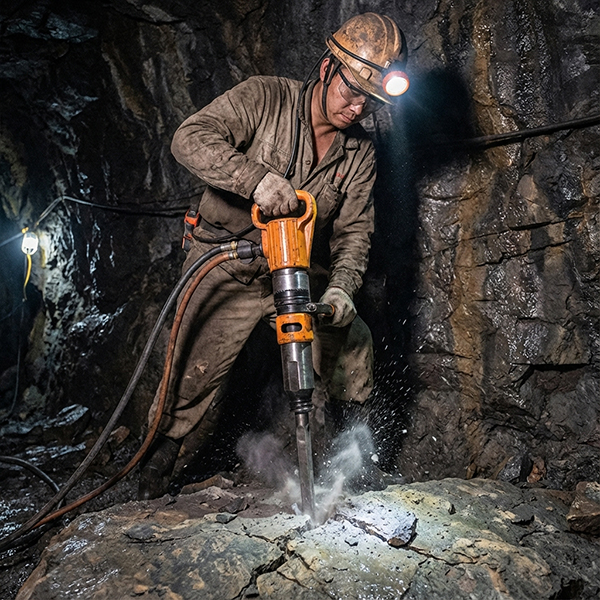
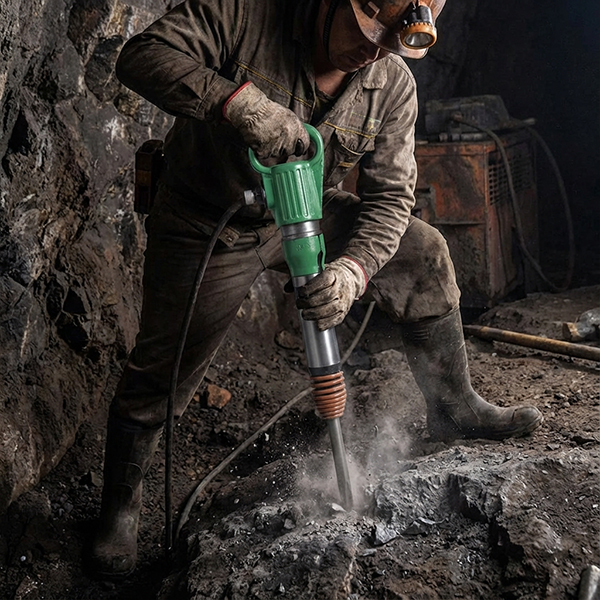
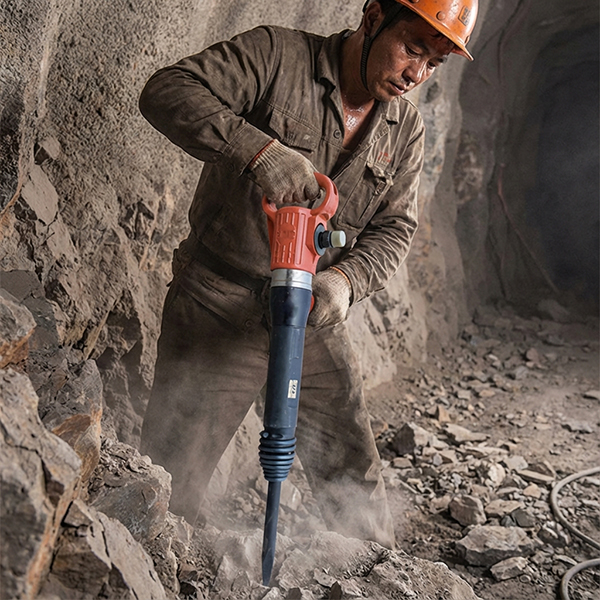
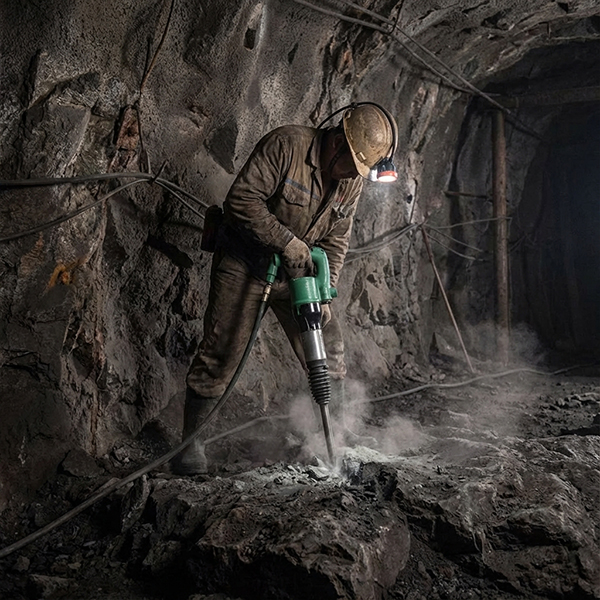
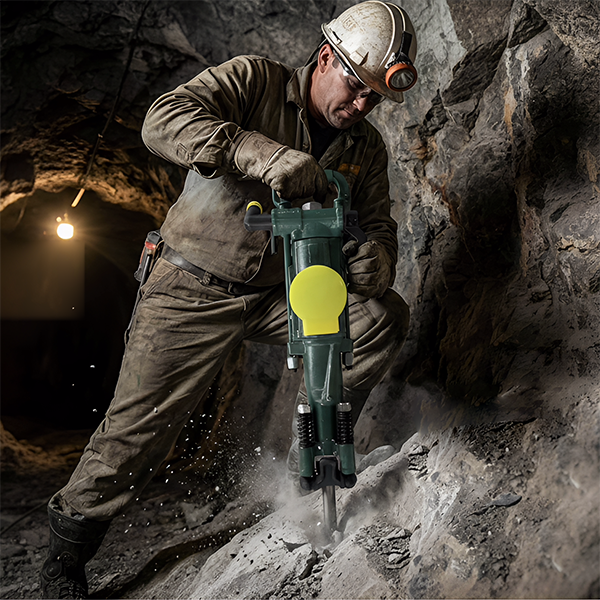
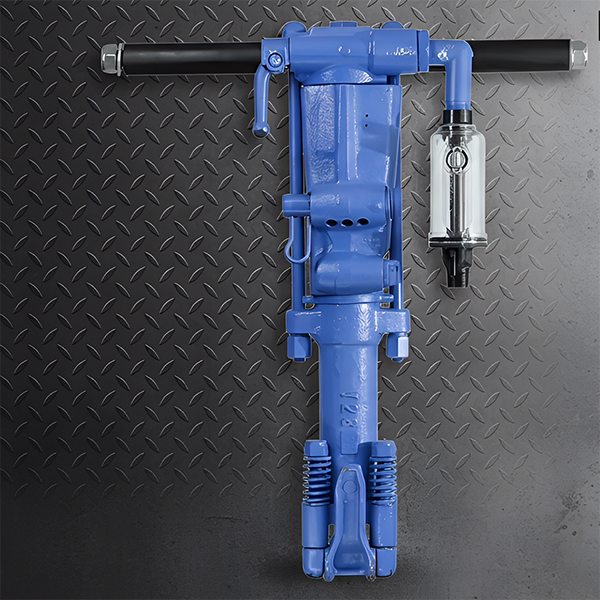
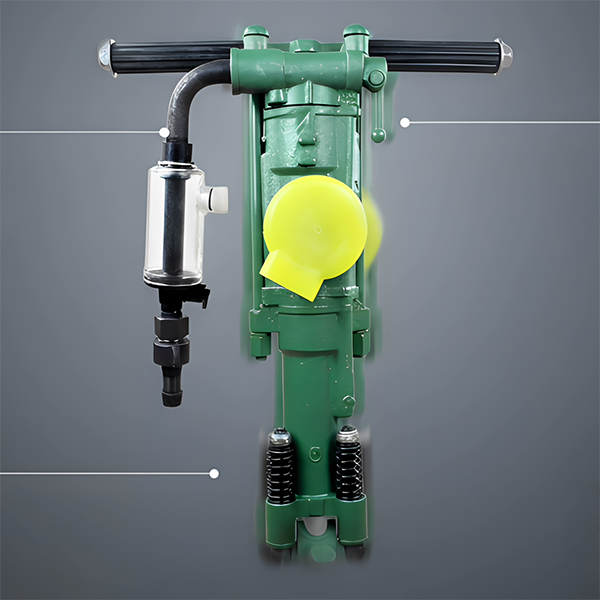
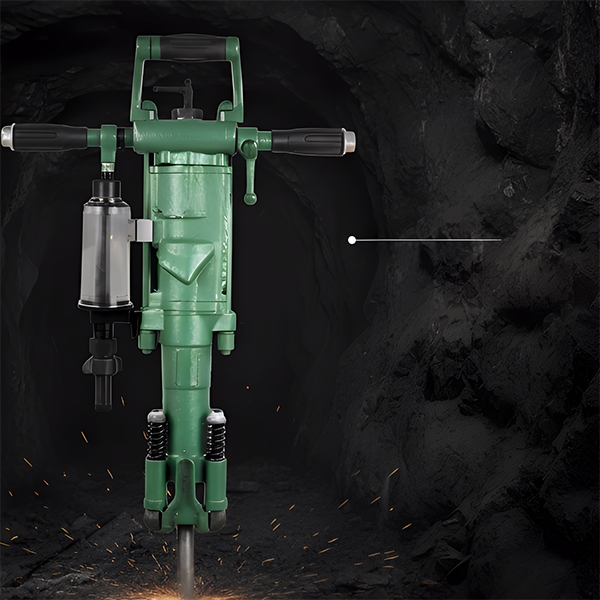
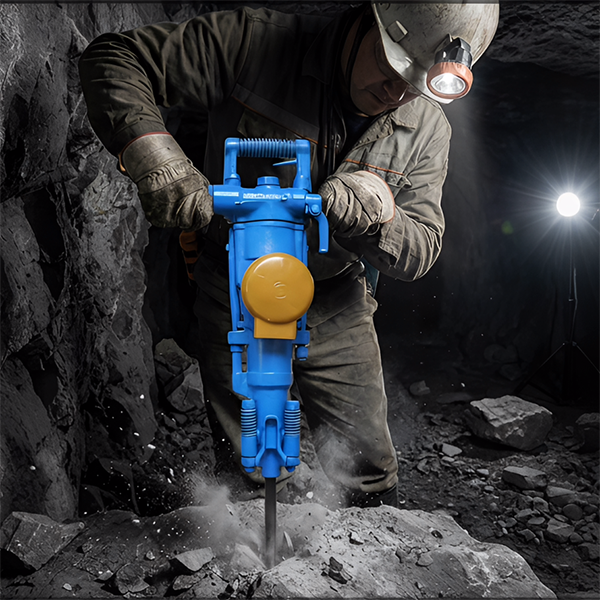
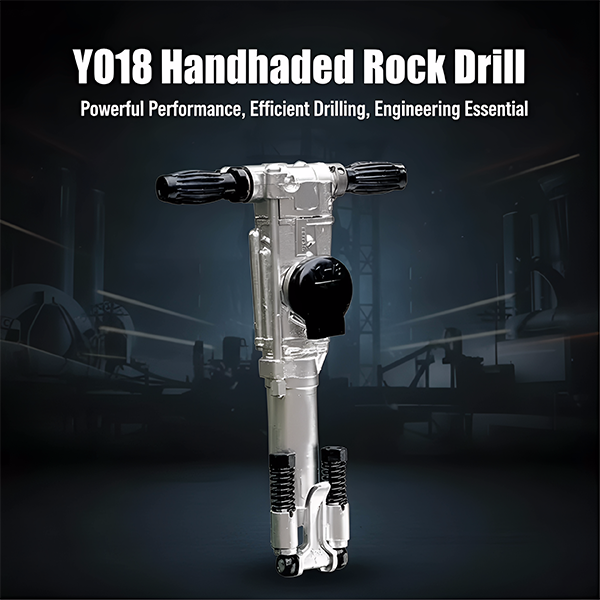
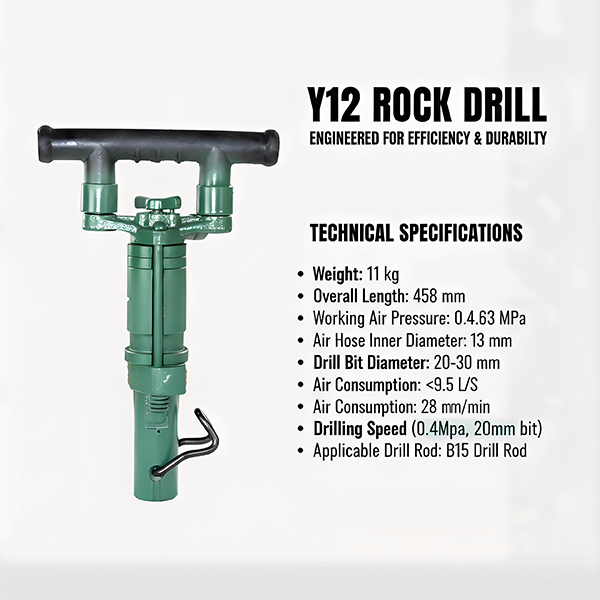
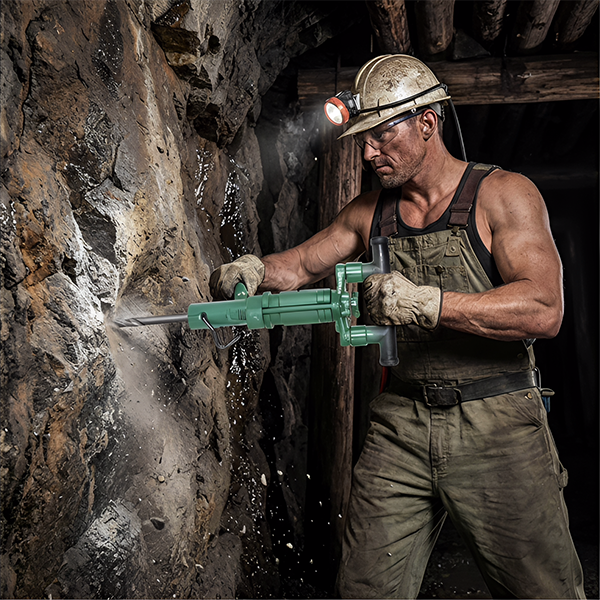
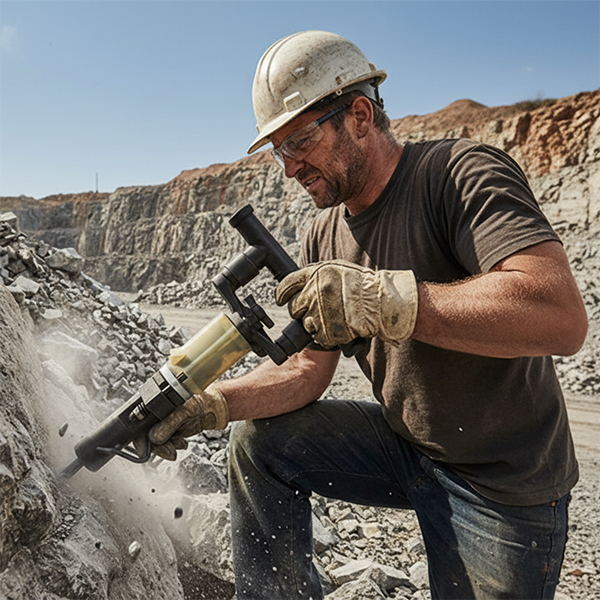
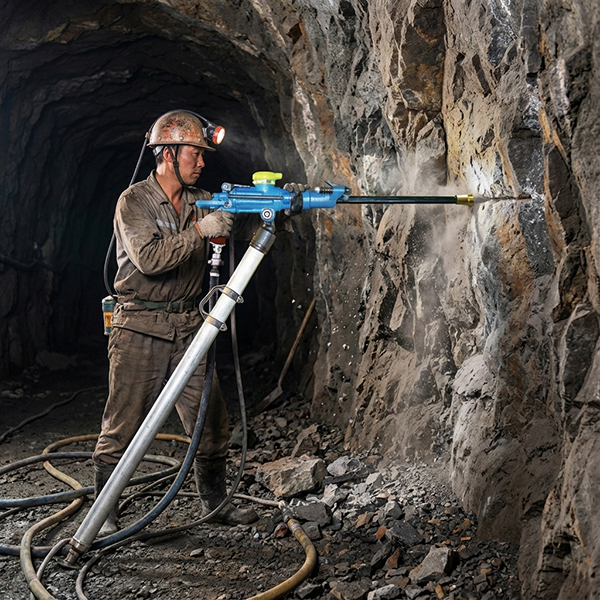
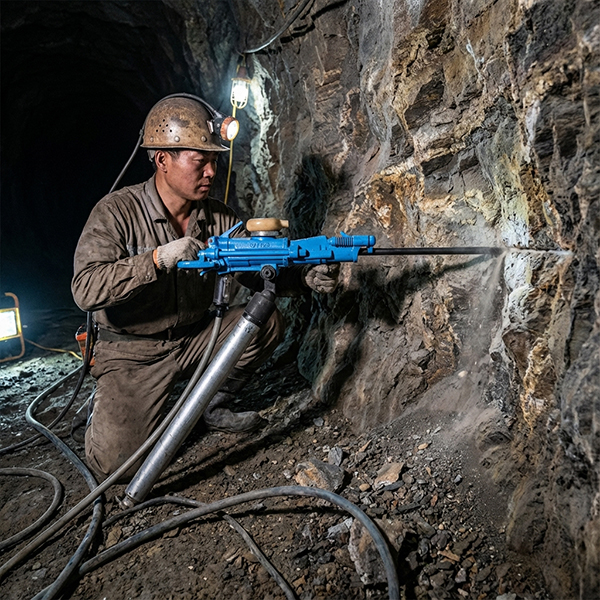
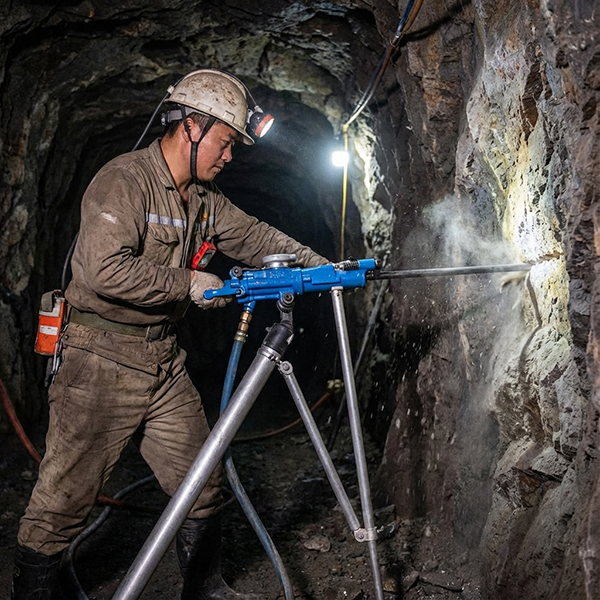
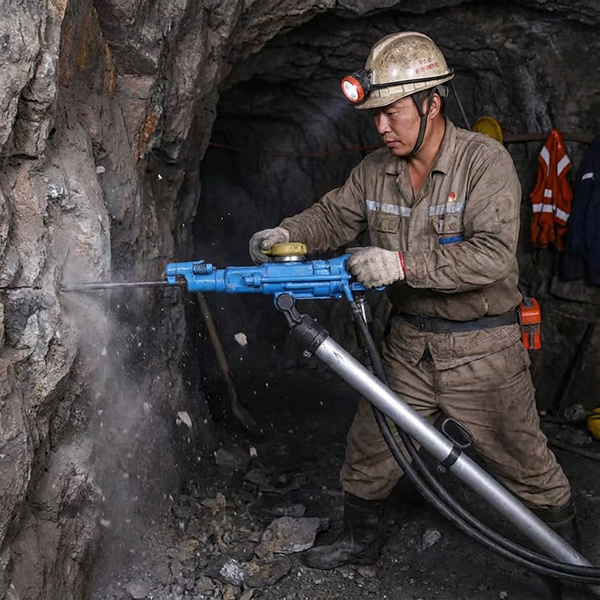
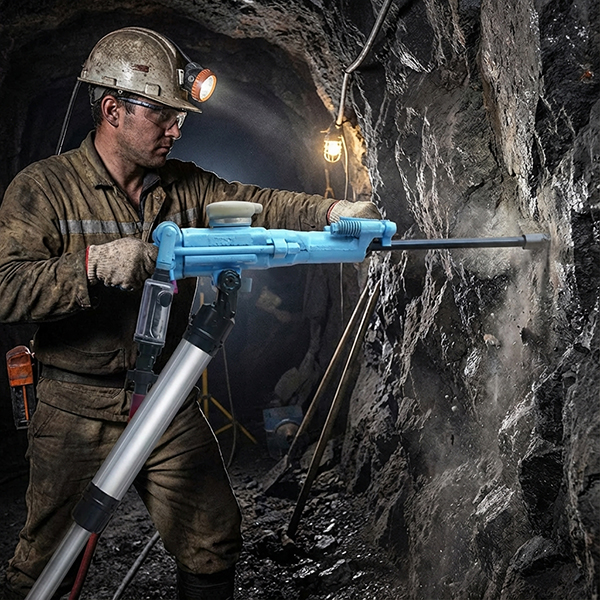
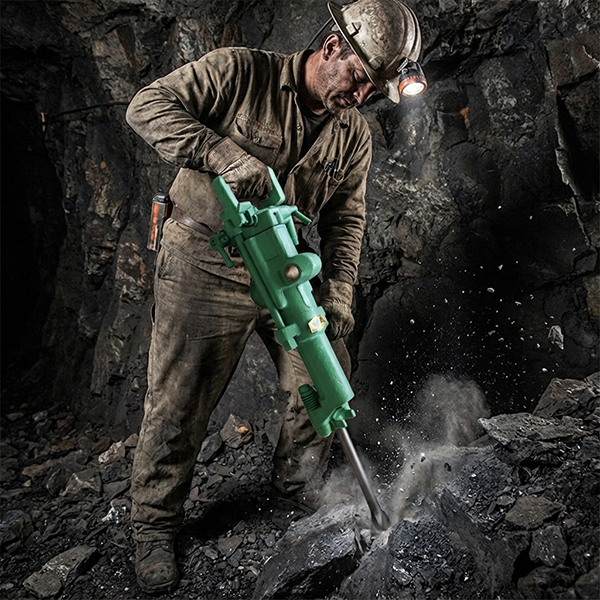
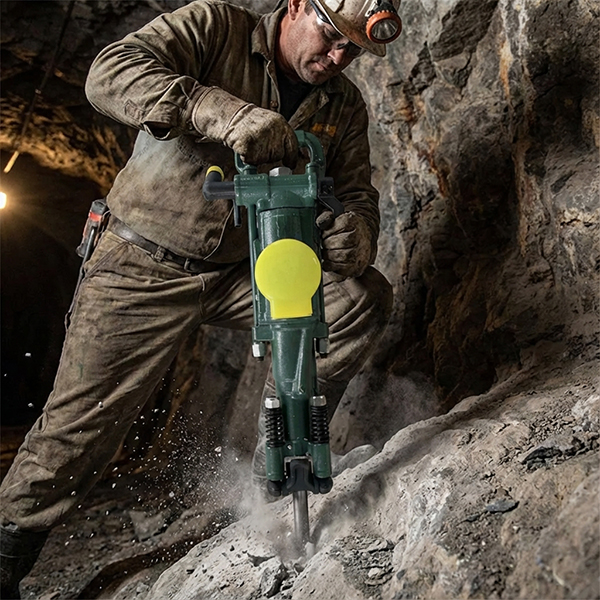
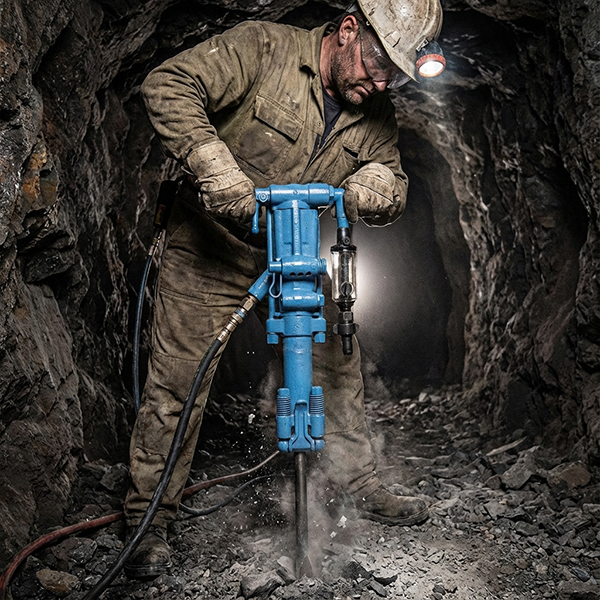
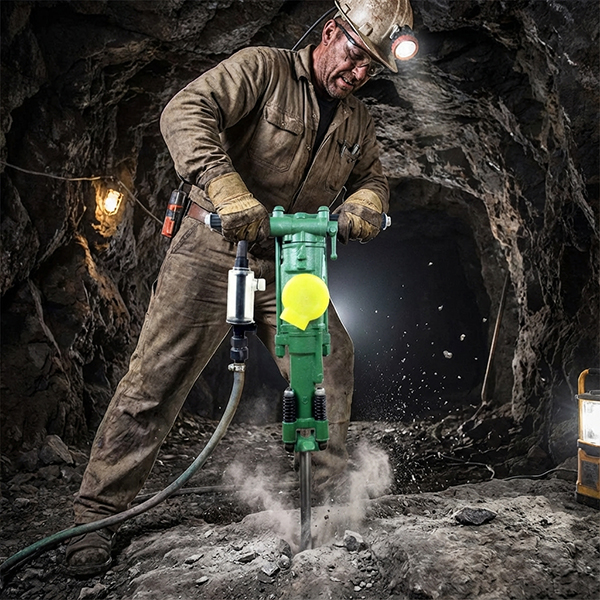
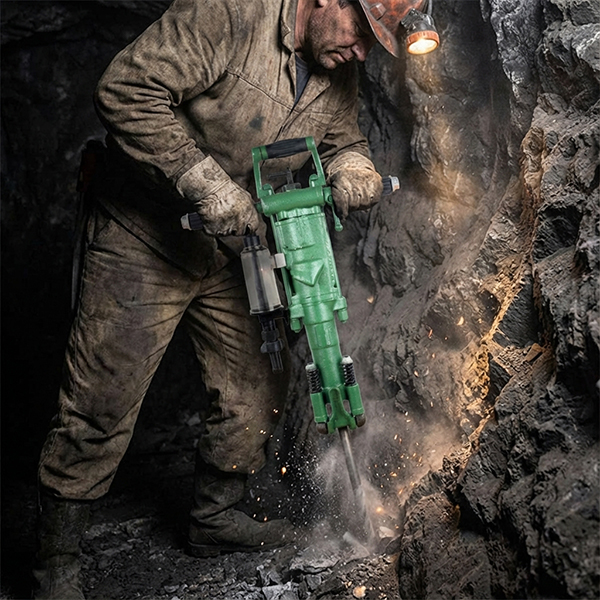
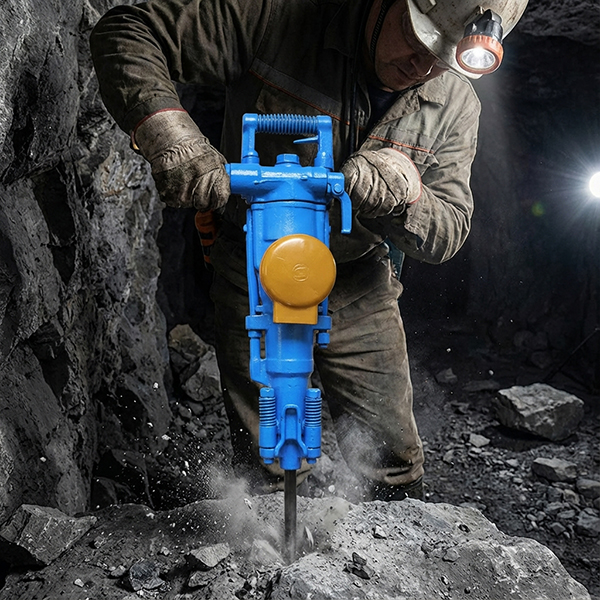
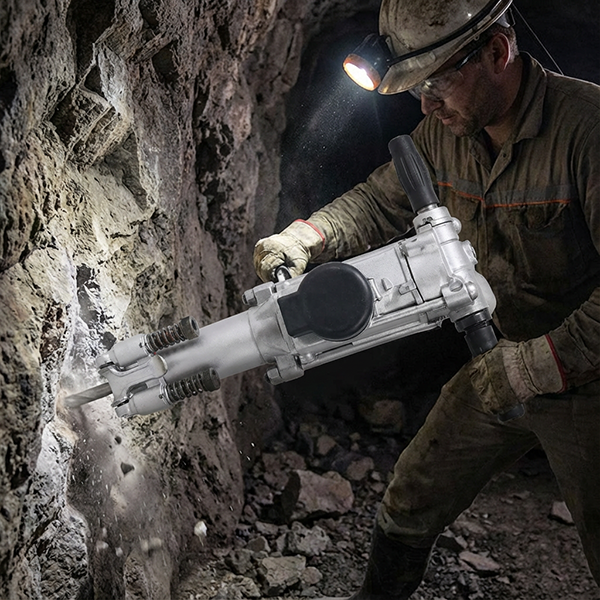
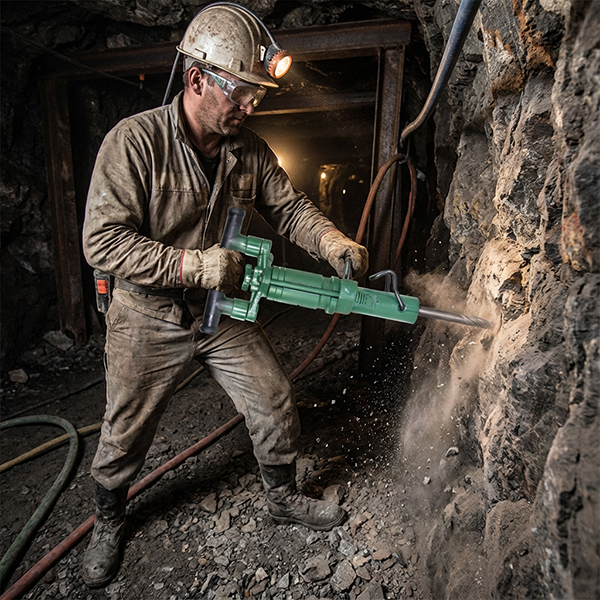
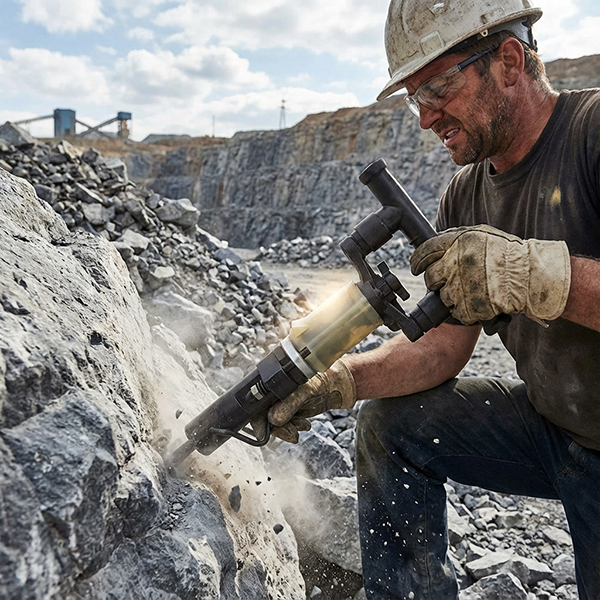
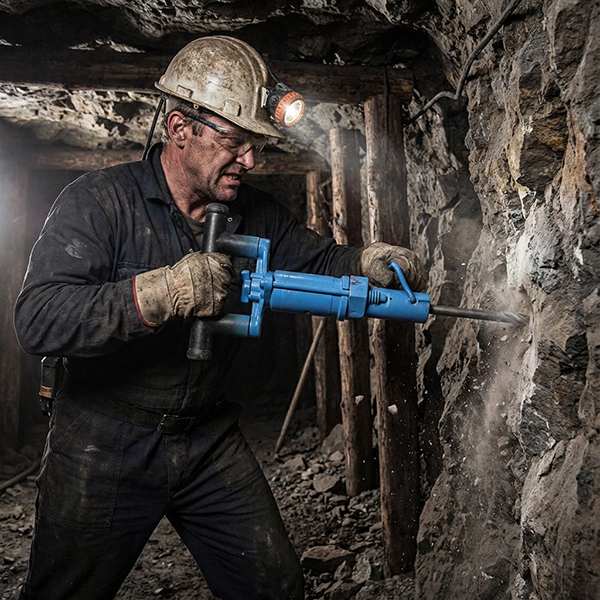
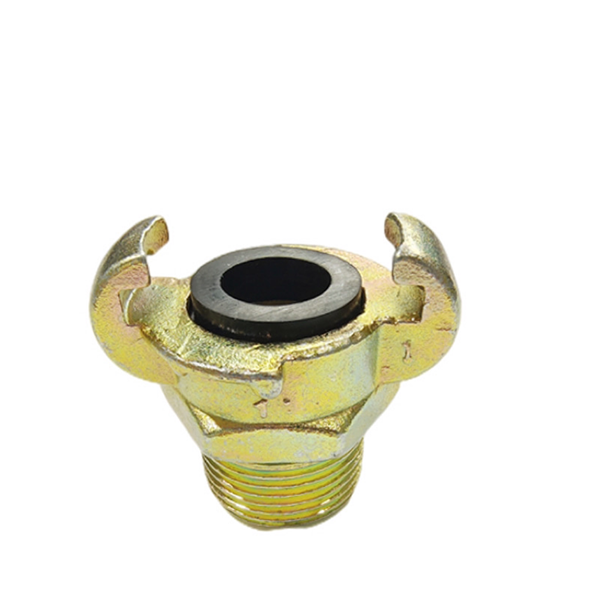
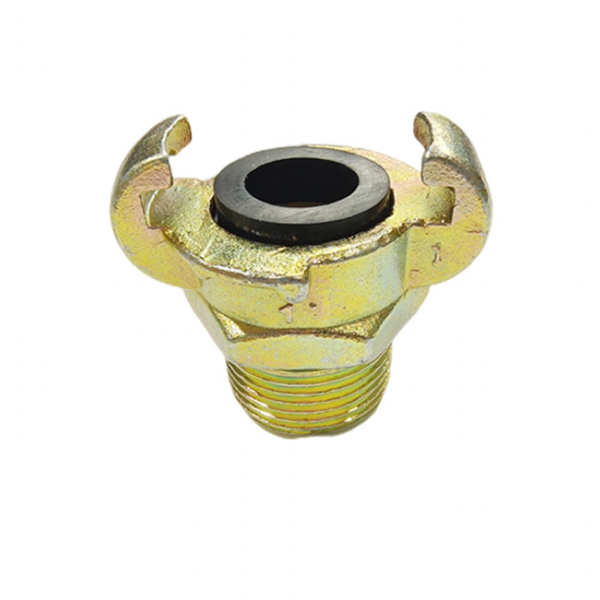
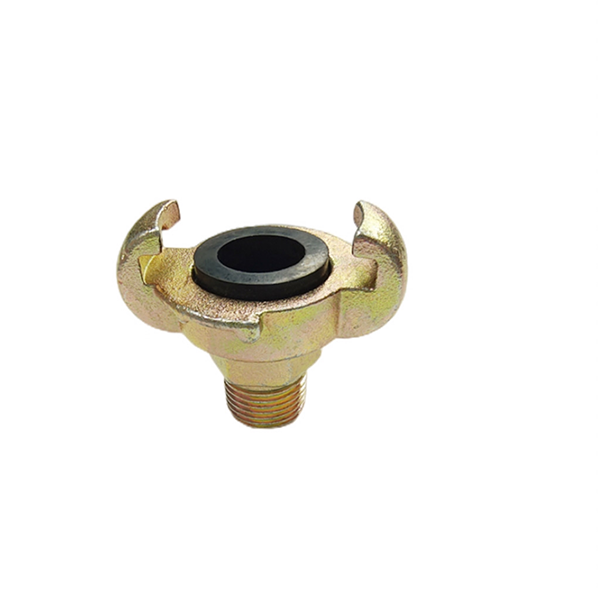
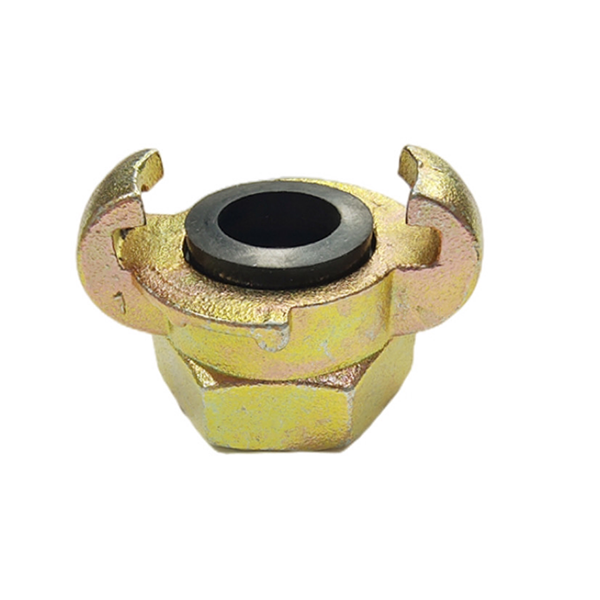
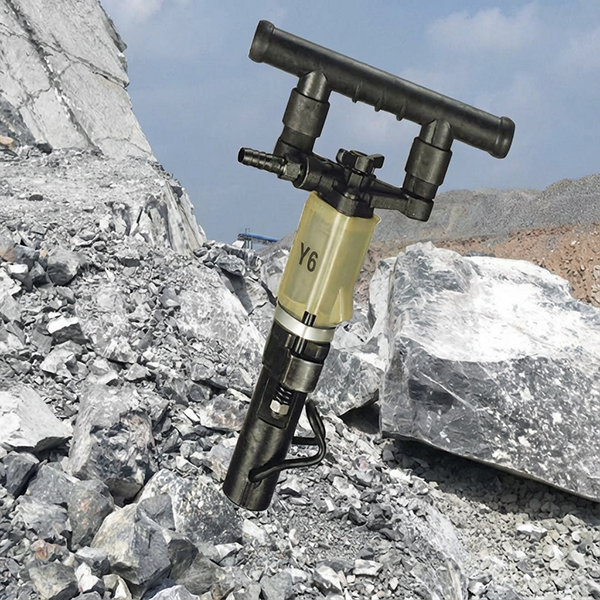
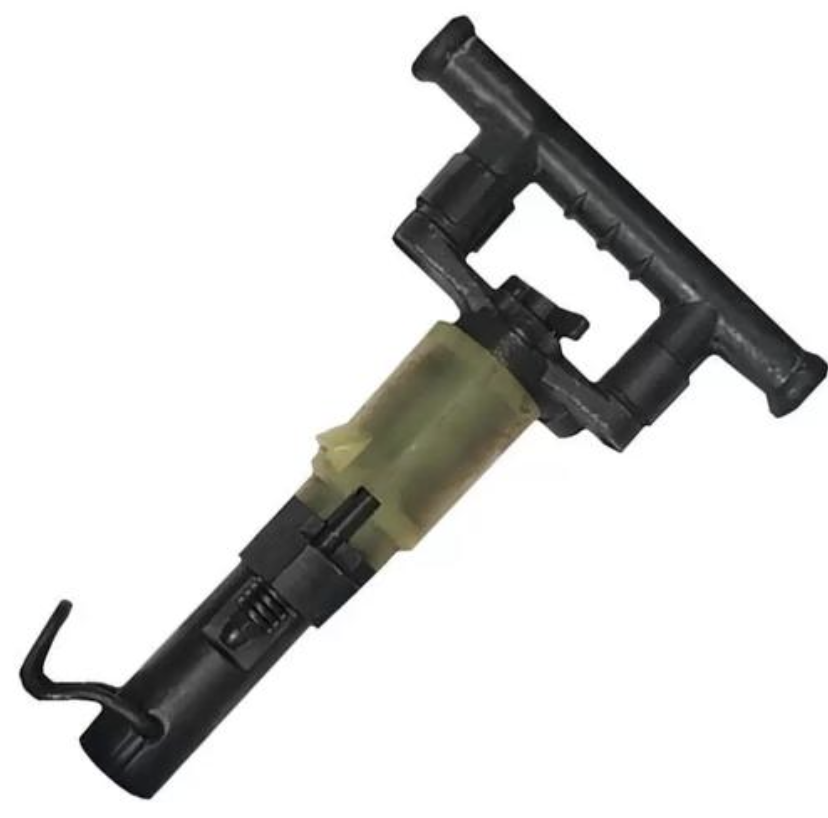
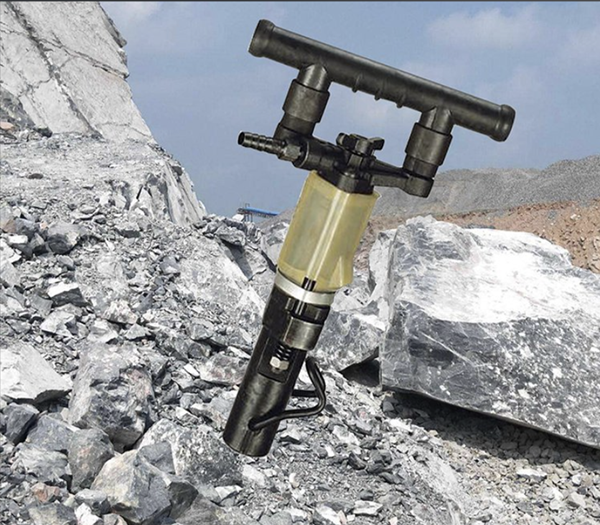
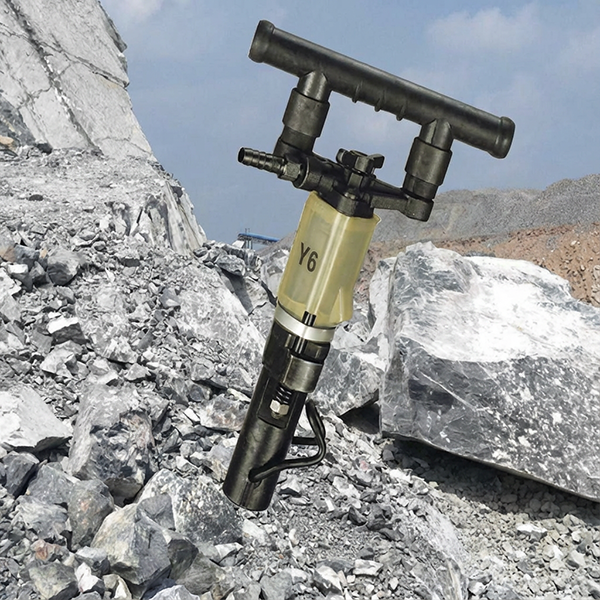
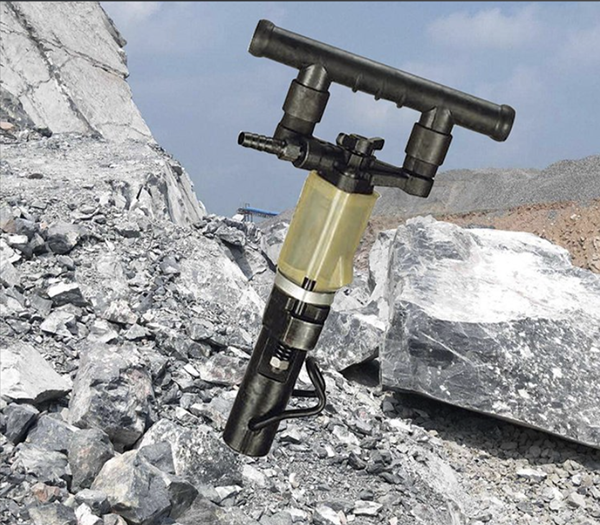
If you need a light, easy‑to‑carry hand held jack hammer for drilling small blast holes or anchor holes in hard rock, the Y6 hand‑held rock drill is designed for exactly that job. It is a compact Pneumatic jack hammer that uses compressed air as its power source and combines impact and rotation to break rock efficiently.
With a weight of only 6 kg and an overall length of 428 mm, the Y6 is much lighter than typical leg‑type jack hammers (which are often 23–30 kg). That makes it very suitable for small quarries, mine auxiliary work, road maintenance, slope trimming, and various construction jobs where you need a portable air jack hammer rather than a heavy machine with a support leg.
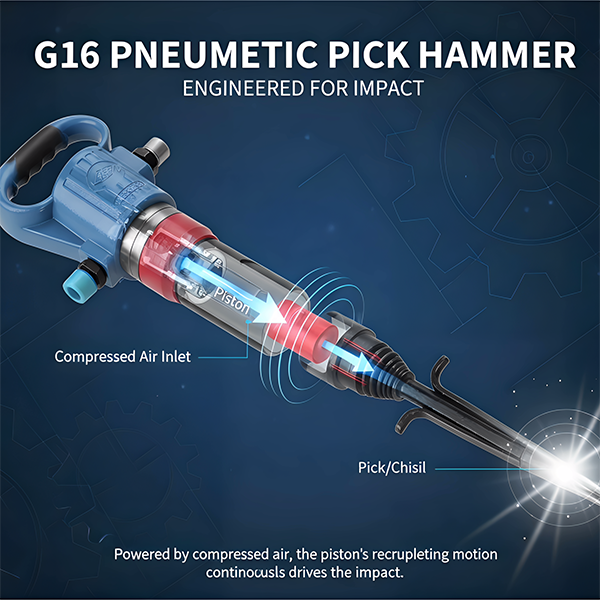
The Y6 works in the standard pneumatic rock drill way: a high‑frequency piston repeatedly strikes the drill rod (B15‑2.8‑4 type), the drill bit (20–24 mm) rotates a small angle after each blow, and compressed air flushes the cuttings out of the hole. This is the same basic working principle used in larger Pneumatic jack hammers and air drifters, just optimized here for a lighter, hand‑held tool.
Key Specifications of the Y6 Hand‑Held Jack Hammer
Type: hand‑held Pneumatic jack hammer (air rock drill)
Weight: 6 kg
Full length: 428 mm
Operating air pressure: 0.40–0.63 MPa (4–6.3 bar)
Inner diameter of air hose: 13 mm
Drill bit diameter: 20–24 mm
Rock drilling rate: ≈180 mm/min
Test condition: air pressure 0.40 MPa, drill bit 20 mm
Air consumption: < 9.5 L/s (free air, at 0.40 MPa)
Matched drill rod: B15‑2.8‑4 drill rod
These parameters put the Y6 in the category of small, light, hand‑held jack hammers used mainly for small‑diameter, relatively shallow blast holes in medium‑hard to hard rock.
How the Y6 Pneumatic Jack Hammer Works
The Y6 follows the classic impact + rotation rock drilling principle described in your technical data:
Inside the cylinder, a piston makes high‑frequency reciprocating motion.
Each forward stroke, the piston strikes the tail of the drill rod, sending an impact through the rod to the drill bit.
Under this impact, the wedge‑shaped drill bit (20–24 mm) penetrates into the rock and forms a small indentation.
When the piston returns, the drill rod is forced to rotate by a certain angle, so the next blow hits a fresh spot on the rock.
The rock between adjacent indentations is sheared off, forming rock chips.
At the same time, compressed air is delivered through the internal channel of the drill rod or flushing passage to blow the rock dust out of the hole, forming a clean, round blast hole.
This is essentially the same working principle you find in larger air drifters, leg rock drills and other Pneumatic jack hammers:
continuous impact from the piston,
step‑by‑step rotation of the drill bit,
and continuous air (or water) flushing to clear cuttings.
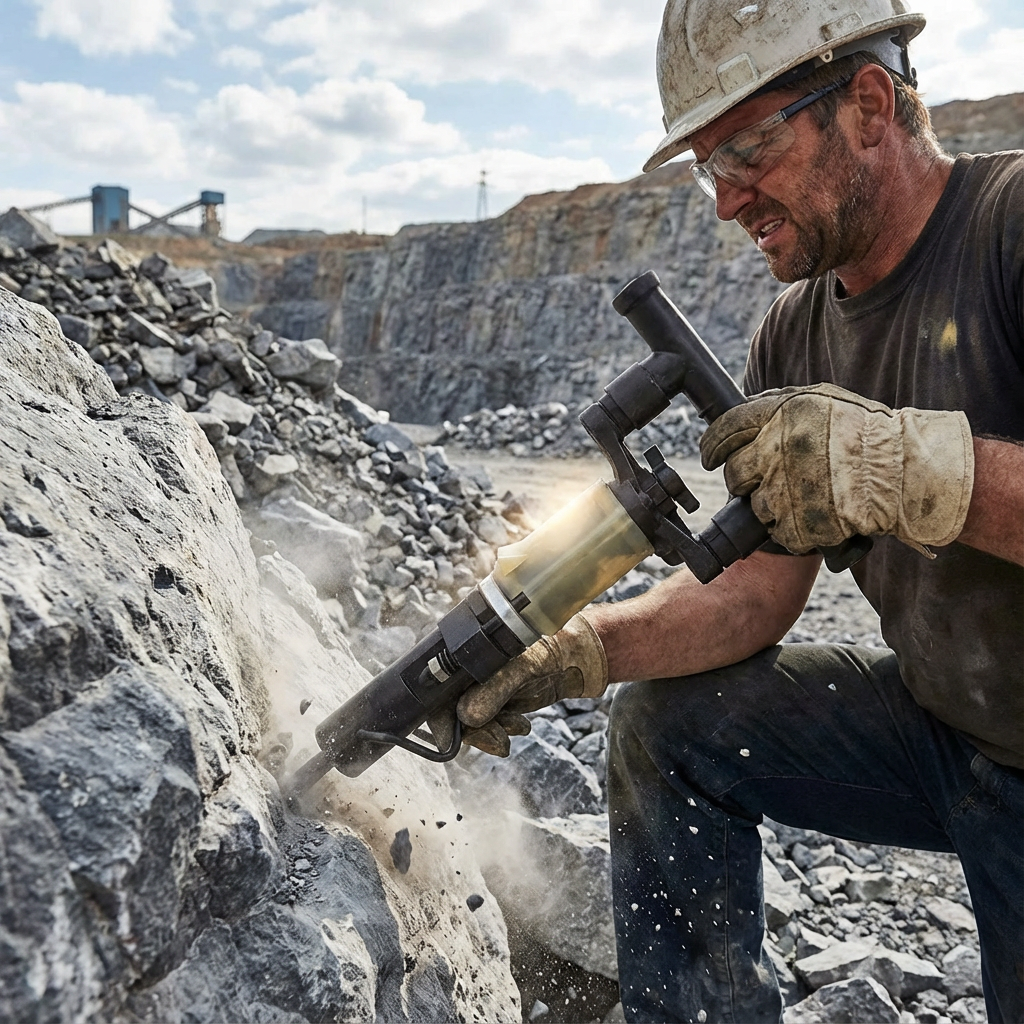
Because the Y6 is only 6 kg, it is very convenient to hold in your hands and apply the needed feed force manually, without any extra air leg or feed device. That’s why it fits well into the “hand‑held rock drill” / “hand held jack hammer” category in the rock drill classification you provided.
Typical Applications of the Y6 Hand Held Jack Hammer
Based on its size, air consumption and drilling rate, the Y6 is mainly used for:
Small‑diameter blast holes
Hole diameter about 20–24 mm
Ideal for short blast holes in underground mine auxiliary work, small tunnel headings, and civil construction.
Shallow to medium shallow holes
Hand‑held rock drills are generally used for shallow blast holes, support holes, and trimming work, where a large leg‑type machine or hydraulic rig would be overkill.
Medium‑hard to hard rock
Pneumatic rock drills are widely used on rock with hardness around f = 8–18 in your data. With proper bits, Y6 can work in similar rock conditions, as long as hole diameter and required depth match its size.
Confined, hard‑to‑reach areas
At 6 kg and 428 mm length, the Y6 can be used in positions where a 25–30 kg air leg jack hammer cannot fit or is too heavy for the operator.
If your main job is small‑diameter holes, frequent relocation of the tool, and work in tight spaces, a lightweight Pneumatic jack hammer like Y6 is usually more efficient and less tiring than a bigger rock drill.
Frequently Asked Questions About the Y6 Pneumatic Jack Hammer
Below are some typical questions that end users often ask, answered using the product parameters and the rock drill knowledge you provided.
1. What drilling performance can I expect from the Y6?
Under the test condition:
Air pressure: 0.40 MPa
Drill bit diameter: 20 mm
the specified rock drilling rate is about 180 mm/min.
In real work, the actual drilling speed will be affected by:
Rock hardness (harder rock → slower)
Bit diameter (24 mm bit will be a little slower than 20 mm)
Air pressure (0.4–0.63 MPa range; closer to 0.5–0.55 MPa usually gives better performance, as your data suggests that 0.45–0.55 MPa is a good range)
Bit sharpness and operator skill
For a small hand‑held jack hammer at <9.5 L/s air consumption, ≈180 mm/min at 0.4 MPa is a reasonable and realistic drilling rate on medium‑hard rock.
2. What kind of air compressor do I need?
The air consumption of the Y6 hand‑held jack hammer is:
< 9.5 L/s at 0.40 MPa
which is about 0.57 m³/min of free air.
When you choose an air compressor, it’s better to keep some safety margin, because:
You need stable working pressure in the range 0.40–0.63 MPa
Long hoses, fittings and water separators all cause pressure loss
There may be other Pneumatic tools using air at the same time
In practice, for one Y6 Pneumatic jack hammer, many users will choose a compressor with at least 1.0–1.5 m³/min capacity at 0.5–0.6 MPa if possible. This is consistent with the general recommendation in your data that wind (air) pressure should be about 0.45–0.55 MPa, not lower than 0.4 MPa, to avoid significant loss of efficiency.
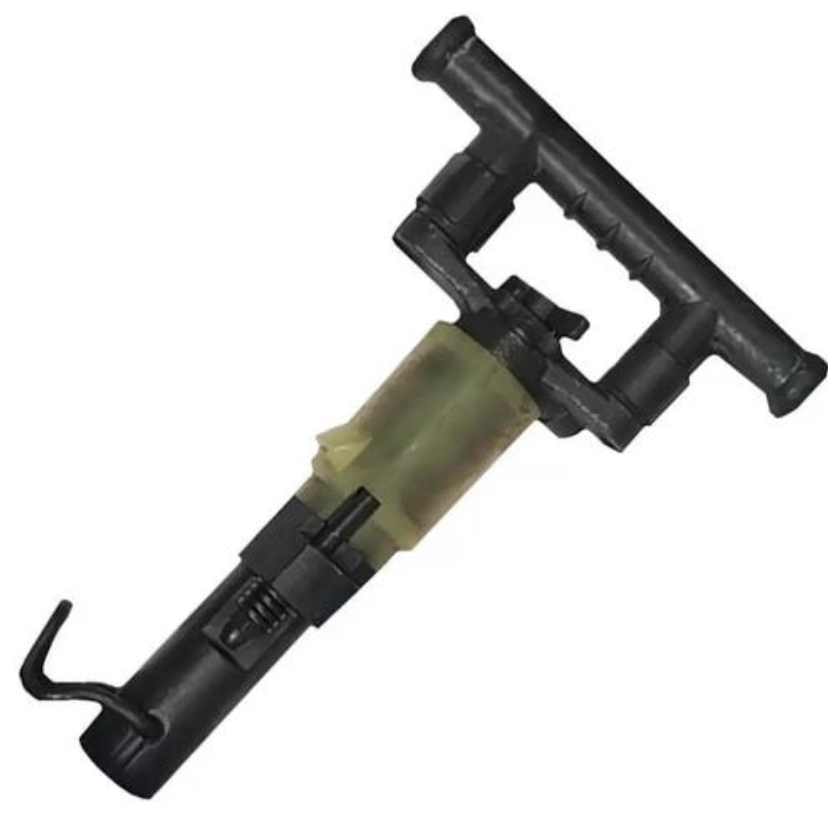
3. Is the Y6 hand held jack hammer easy to carry and operate?
Yes. This is one of its main advantages.
From your classification, hand‑held rock drills are supposed to be lightweight (generally <30 kg) and are mainly used for small‑diameter shallow holes. The Y6 is only 6 kg, which is far below that threshold.
Compared with:
Leg‑type pneumatic rock drills (typically 23–30 kg just for the main machine, plus the air leg)
Upward or rail‑type drills (usually 30–100 kg or more)
the Y6 hand‑held jack hammer is:
Much easier to carry on foot
Quicker to reposition between drilling points
Less tiring for short, repetitive jobs
For contractors who work on small face areas, frequent moves, or on slopes and scaffolds, this small Pneumatic rock drill is often more convenient than a heavier air leg drill.
4. What drill rod and drill bit does the Y6 use?
According to the parameter sheet:
The Y6 is matched with B15‑2.8‑4 drill rod
The recommended drill bit diameter is 20–24 mm
In line with the rock tool information you provided earlier:
Rock drill rods are typically made from high‑quality drill steel, often hexagonal (middle hexagon) hollow section, with a bit on one end and a shank (tail) on the other.
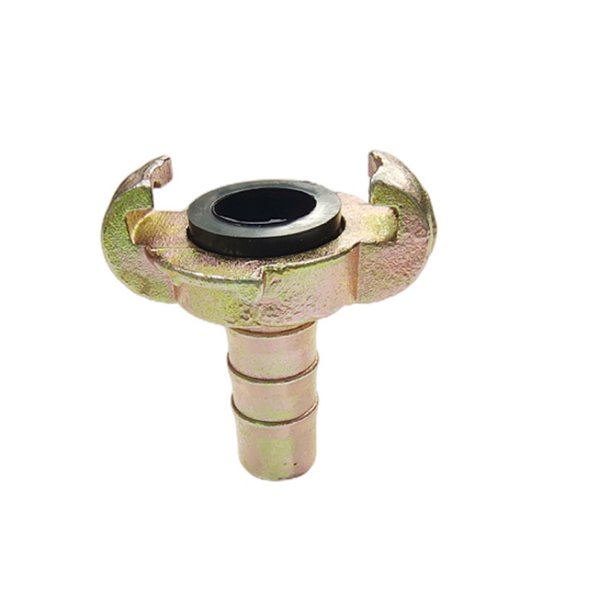
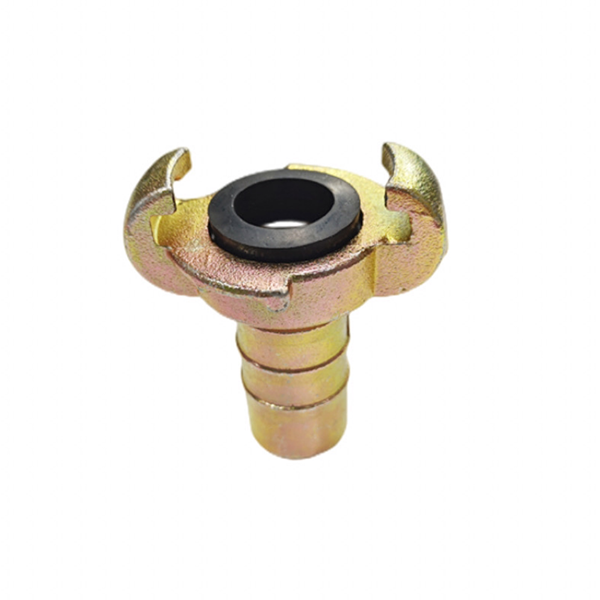
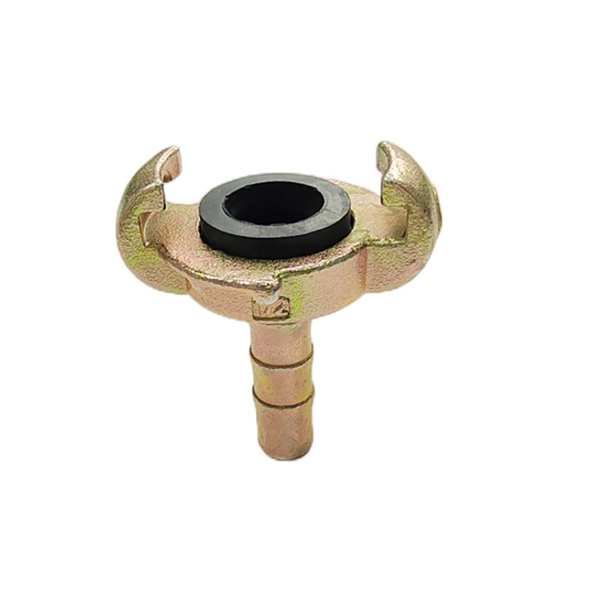
The Y6 uses a B15 shank interface, so you should choose drill rods and bits specifically made for B15‑2.8‑4 to ensure proper fit and long life.
For small hand‑held jack hammers like this, a 20 mm bit is a good choice when drilling in harder rock and when you want to maintain good penetration rate.
If you need to drill slightly larger holes (up to 24 mm), you can use a larger bit, but expect the penetration rate to be lower than the 180 mm/min figure measured at 20 mm and 0.4 MPa.
5. How should I set and control air pressure for Y6?
Your general maintenance data for Pneumatic rock drills says:
Working wind (air) pressure should be 0.45–0.55 MPa
Below 0.4 MPa efficiency drops significantly
Above 0.55 MPa, parts wear faster
The Y6 itself is rated for:
Operating air pressure: 0.40–0.63 MPa
In real use, that means:
Try to keep your working pressure at the machine inlet around 0.4–0.55 MPa
Avoid running continuously at the very top of the range (0.63 MPa), unless you really need maximum output and you accept faster wear
If the pressure at the compressor is 0.6 MPa, make sure that at the machine’s air inlet (after hose, filters, etc.) you still get at least about 0.4–0.45 MPa when drilling
Proper air pressure is important not only for power, but also for:
Stable impact frequency
Adequate torque (to avoid bit stalling or “stuck drill”)
Reasonable air consumption and operating cost
6. What about lubrication and daily maintenance?
Your maintenance guidelines for pneumatic rock drills are very clear, and they apply fully to a hand held jack hammer like the Y6:
Clean and oil a new machine before use
Before the first use, open the Y6, clean off factory anti‑rust oil, check main parts, and re‑assemble with proper lubricating oil on the mating surfaces.
Use clean, dry compressed air
Before connecting the hose, blow out moisture and dirt in the air line. Dirt and water carried into the rock drill can score the cylinder and valve surfaces and reduce life.
Use a proper in‑line oiler (automatic oiler)
Exhaust air contains an oil mist
Drill shank shows a light oil film during work
Fill the oiler with clean lubricating oil, not waste oil or grease.
For Pneumatic jack hammers, typical oil consumption is around 3–4 ml/min based on your data. Adjust the oiler so that:
Never run without oil
Your instructions are strict: no dry running, and no grease lubrication. Running without oil will quickly wear the piston, cylinder and valve surfaces.
Start with low air and short idle run
When starting, open the air valve slightly and let the jack hammer run 2–3 minutes at low speed to warm up and check if everything is normal, just as your general guideline says “small air first, idle for 3–5 minutes”.
Check bolts and hose connections regularly
Even on a small 6 kg rock drill, vibrations can loosen fasteners.
Pay attention to nuts on long bolts and hose connections; retighten when needed to avoid damage or hose whipping.
After work, blow out moisture
Close the water (if water flushing is used), then let the rock drill run shortly on air only to blow out remaining water from inside, preventing rust.
If the machine will be stored for a long time, dismantle, clean, oil the parts and store it in a dry place.
Although the Y6 is small, it still uses high‑frequency impact. Good lubrication and clean air are vital to maintain its performance and extend its service life.
7. Is the Y6 suitable for wet drilling?
The general rule in your data is:
Water pressure must be lower than air pressure
Water pressure should not be equal to or higher than the wind pressure
If water pressure is higher, water can flow back into the machine, wash away oil film, and accelerate wear.
The Y6 is mainly specified as a hand‑held Pneumatic rock drill, so it is commonly used with air flushing for dry or semi‑dry drilling. If your system is configured with water flushing:
Make sure the water pressure is lower than the air pressure at the drill
Observe the exhaust: if you see too much water and no oil mist, it may be washing out the lubrication
After wet drilling, it is important to run the jack hammer briefly with air only to blow out water and then add oil before storage
If dust control is a big concern, wet drilling or water mist with a Pneumatic jack hammer can help, but the installation depends on your site conditions and the version of the Y6 you purchase (with or without water connection).
8. How does a small hand held jack hammer like Y6 compare to leg‑type or hydraulic drills?
From your product knowledge:
Pneumatic rock drills are simple, reliable and widely used, but their energy utilization is lower and noise is higher than hydraulic drills.
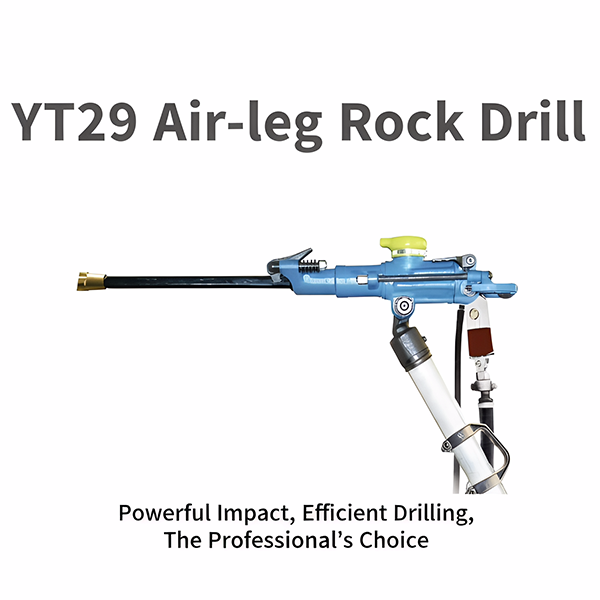
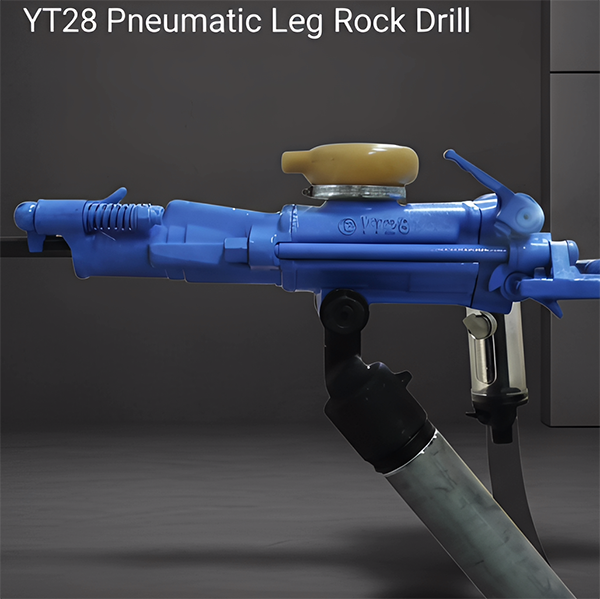
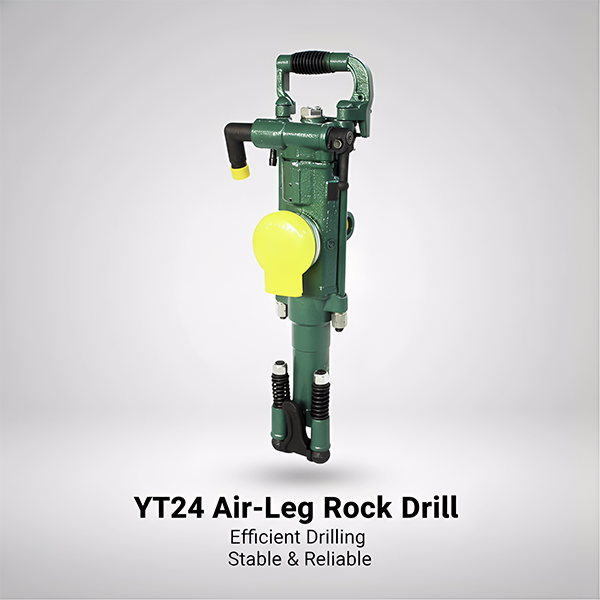
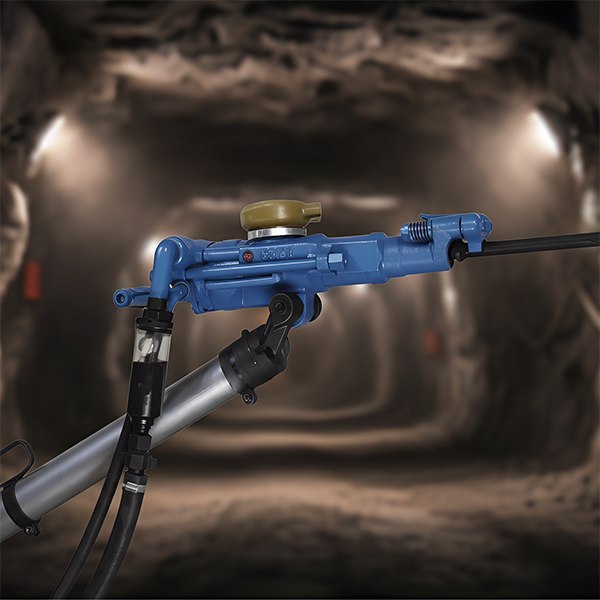
Leg‑type pneumatic rock drills (YT24, YT26, YT28, etc.) weigh around 23–30 kg, use air legs for thrust and can drill 32–45 mm holes up to about 5 m deep.
Hydraulic rock drills have higher efficiency and lower noise, but systems are more complex and cost is higher.
Position of Y6:
Y6 is a small hand held Pneumatic jack hammer for 20–24 mm holes.
It weighs only 6 kg, so it’s not designed to replace a heavy air leg drill on long, deep holes.
Its strength is flexibility and portability: small diameter, shallow holes, short operations in many different positions.
If you mainly drill deep holes in tunnels and need high productivity on 32–45 mm holes, a leg‑type pneumatic rock drill or hydraulic rig is better.
If your main work is small blast holes, short support holes, trimming, or light stonework, a Y6 hand‑held jack hammer is often the more economical and practical choice.
Summary: Why Choose the Y6 Hand‑Held Rock Drill?
The Y6 hand‑held rock drill is a compact, efficient Pneumatic jack hammer designed around the core principles in your technical data:
compressed air as power,
high‑frequency impact + rotation,
and reliable flushing and lubrication.
Key reasons customers choose the Y6:
Very light and portable: only 6 kg, 428 mm length – easy to carry and operate by hand.
Optimized for small holes: 20–24 mm bit diameter, tested 180 mm/min drilling rate at 0.4 MPa and 20 mm bit.
Low air consumption: less than 9.5 L/s, so it can work with relatively small air compressors.
Standard pneumatic design: works at 0.40–0.63 MPa air pressure, matching the usual 0.45–0.55 MPa range recommended for Pneumatic rock drills.
Mature technology: uses the same impact and flushing principle as larger hand held jack hammers, plus all the well‑known maintenance practices (clean air, correct oiling, proper pressure control).
If you are looking for a hand held jack hammer / Pneumatic jack hammer for 20–24 mm holes, where light weight, flexibility and low air consumption are more important than deep‑hole capacity, the Y6 is a very practical option. With correct air supply, proper lubrication and regular maintenance as described above, it can be a robust and economical tool in your drilling fleet.